Hidden water leaks can waste hundreds of gallons of water daily — and you may never know about it unless your water bill goes up dramatically or until you discover serious damage to your home. one of the best and easiest ways to check your home for silent plumbing leaks (running Toilets; underground pipe leaks; etc.) is to learn how to read your water meter.
Whether you live in Carlsbad, san diego, Oceanside, Encinitas, Vista, San Marcos, or nearby San Diego County communities, a simple water meter check can help you figure out if you have active water usage in your home that you probably should not have.
Why would you want to check your water meter for leaks?
Every homeowner doesn’t always understand what plumbing leaks will appear as. A bursting pipe will clearly produce a puddle of water. However, many leaks happen silently behind walls and/or under flooring and/or in your Toilets, or even directly below your home’s foundation.
In general, common indicators of a possible silent water leak include:
• an unexplained rise in your monthly water bill
• the noise of water running in your pipes when nothing is turned on
• your toilet constantly refilling itself
• damp/warm areas on your flooring
• unusual smells
• Mold/mildew
• Cracks in flooring/ceilings/walls
• low water pressure
• water stains on walls/ceiling
• continuous movement on your water meter
Performing a water meter test can help identify if there is indeed active water flow through your plumbing system when it should not be.
Step 1: locate your water meter
Typically your water meter will be close to the road/street/sidewalk/driveway/boundary of your property.
The type of housing development and/or water utility company serving your area determines where the meter may be housed. In many cases the meter will be housed inside a small underground metal box with a removable top.
Important: do not force open your water meter cover if it is difficult to access. Water utilities companies have varying types of equipment.
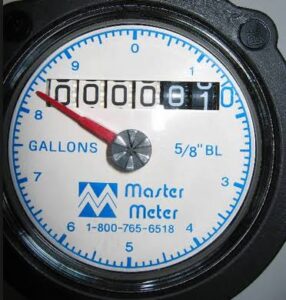
Once you locate the meter, find the face of the meter and the small leak indicator.
Step 2: ensure that all water fixtures are off inside your home
Prior to starting the test ensure that every interior faucet/shower/head is fully closed/off.
Verify that each of the following has also been turned off:
• faucets
• showers
• bathtubs
• Toilets
• washing machines
• dishwasher
• refrigerator water dispenser
• automatic sprinklers/Irrigation systems
• pool/water feature
• any outdoor spigots/faucets
If you have automated appliances or Sprinkler systems that utilize water, disable these during the test period. Do not begin testing until you are positive that no water is being used anywhere in the home.
Step 3: inspect the water meter
After verifying that all indoor water fixtures have been shut-off inspect the water meter.
Most residential water meters have a small triangular/star-shaped/circular leak indicator. Digital meters will typically show different levels of usage.
Observe the meter for a few minutes.
What should happen during this time frame?
If no water is being utilized throughout the home, the meter should remain relatively still.
If the meter continues showing active water flow:
It would suggest there is an unknown source of water utilization somewhere in your home’s plumbing system.
Even slight motion of the needle is significant enough to warrant further investigation.
Step 4: conduct a more thorough leak test using your water meter
Take an initial reading from your water meter. Write down the number(s) or capture a picture of the meter reading.
Leave all water fixtures in the home off for at least 30-60 minutes to allow any small leak to develop and possibly produce measurable results.
Do not use any water during this interval.
Return to the meter and compare readings.
If there was a change in the number(s):
There may be an ongoing active leak somewhere in your home or another source of unexpected water usage.
Next step: determine where is water going?
Step 5: investigate leaks from your Toilets
Leaks from Toilets are among the most prevalent sources of undetected (hidden) household water loss.
Silent leaks from Toilets can occur without producing a puddle.
The food-dye test is one basic method:
1. Remove the toilet tank lid.
2. Add several drops of dye colorant to the tank.
3. Wait approximately 10-15 minutes without flushing the toilet.
4. Observe the color in the bowl.
• if you observe dye-colored water in the bowl, then you likely have a leak occurring from the tank into the bowl.
A malfunctioning flapper or faulty fill valve could be contributing factors.
Why do leaky Toilets matter?
A continually-leaking toilet can lose significant amounts of water over time.
Therefore, prior to making assumptions about having a slab leak due to your meter indicating usage when everything else is turned off, inspect your Toilets first.
Step 6: examine outside plumbing & Irrigation
Also don’t neglect to examine the plumbing outside of your home.
Examine:
1. Hose bibs
2. Irrigation valves
3. Sprinkler system valves
4. Underground Irrigation piping
5. Pool equipment & piping
6. Outdoor spigot/faucets
7. Backflow prevention devices
Possible signs of excessive wet soil/standing water/greener than normal areas of lawn/dampness under parts of lawn when rest of lawn is dry include leaks in underground Irrigation piping. These can look like plumbing issues inside the home.
Step 7: be aware of possible slab leak indicators
If you believe you’ve found evidence of an active leak via your water meter usage, but you haven’t identified an obvious issue elsewhere (e.g., sink, toilet, etc.), there may be a leak in an underground service line feeding into your home.
Slab leaks occur when a portion of an underground service line encircling or embedded within a home’s concrete foundation begins to leak.
Some potential warning signs of a slab leak include:
1. Warm spots on the floor
2. Flooring that feels damp
3. Areas of ground that collect water despite lack of rain
4. Floor Cracking or shifting
5. Sound of water running beneath flooring
6. Lower than usual water pressure
7. Increased cost to monthly water bill
8. Moisture persistently present around baseboards/etc.
9. Presence of Mold/mildew
10. Continuous movement on your water meter when all indoor fixtures are turned off
Identifying a slab leak can be challenging since the damaged section of pipe can be buried deep beneath layers of concrete flooring/building materials/etc.
Doesn’t every little bit of movement on my water meter mean i have a slab leak?
No!
As mentioned earlier, just because your water meter is moving does not automatically mean you have a slab leak.
A moving meter simply suggests that there may be active water usage somewhere within your home’s plumbing system.
Possible causes for continued movement include:
A running toilet
A leaky faucet
A misaligned washer or loose connection on a washing machine/hot-water-heating appliance
A leak in Irrigation piping
A concealed pipe leak
A slab leak
